Written once, then shelved
Policies, plans and procedures written for the audit, by consultants or a stretched few, and out of date by the next one.
IMS Creator drafts every document ISO 55001, 9001, 14001, 45001 and six more standards ask for, from your own facts, for your people to review and approve. Then plugins put them to work: the maintenance, the audits, the risks.
Hosted in Australia · Your data kept apart · Your Claude account, your region
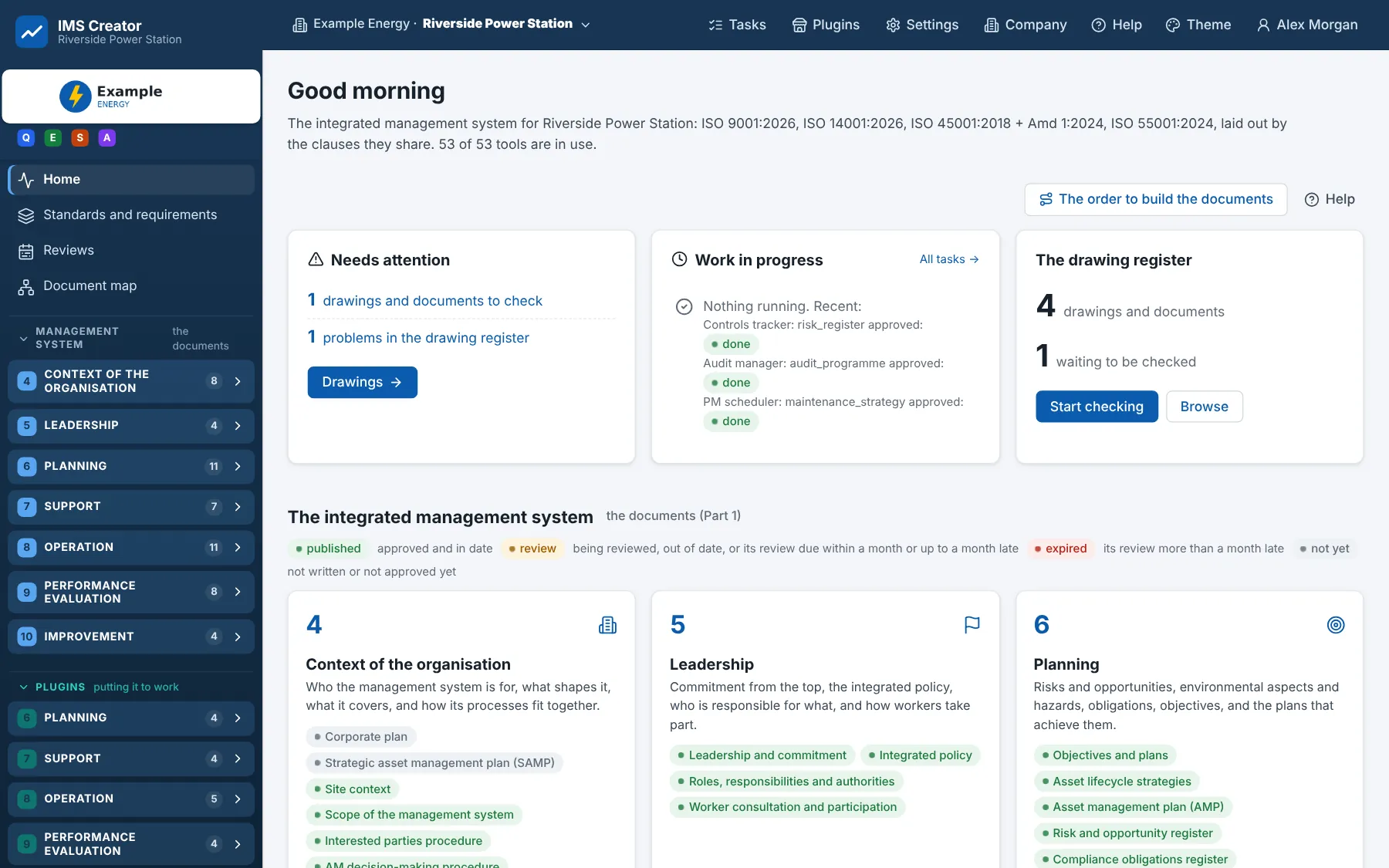
Most organisations hold their certification with documents that took months to write, live in folders nobody opens, and drift from how the site really works.
Policies, plans and procedures written for the audit, by consultants or a stretched few, and out of date by the next one.
Quality, environment, safety and assets each with their own manual and registers, the same clause answered four times over.
The maintenance program says one thing and the work orders another; audits are planned in spreadsheets and findings go missing.
Part one writes the documents your standards ask for. Part two puts them to work, so what you approve is what happens on site.
From the context of the organisation to improvement: the documents and registers clauses 4 to 10 ask for, for the standards you apply.
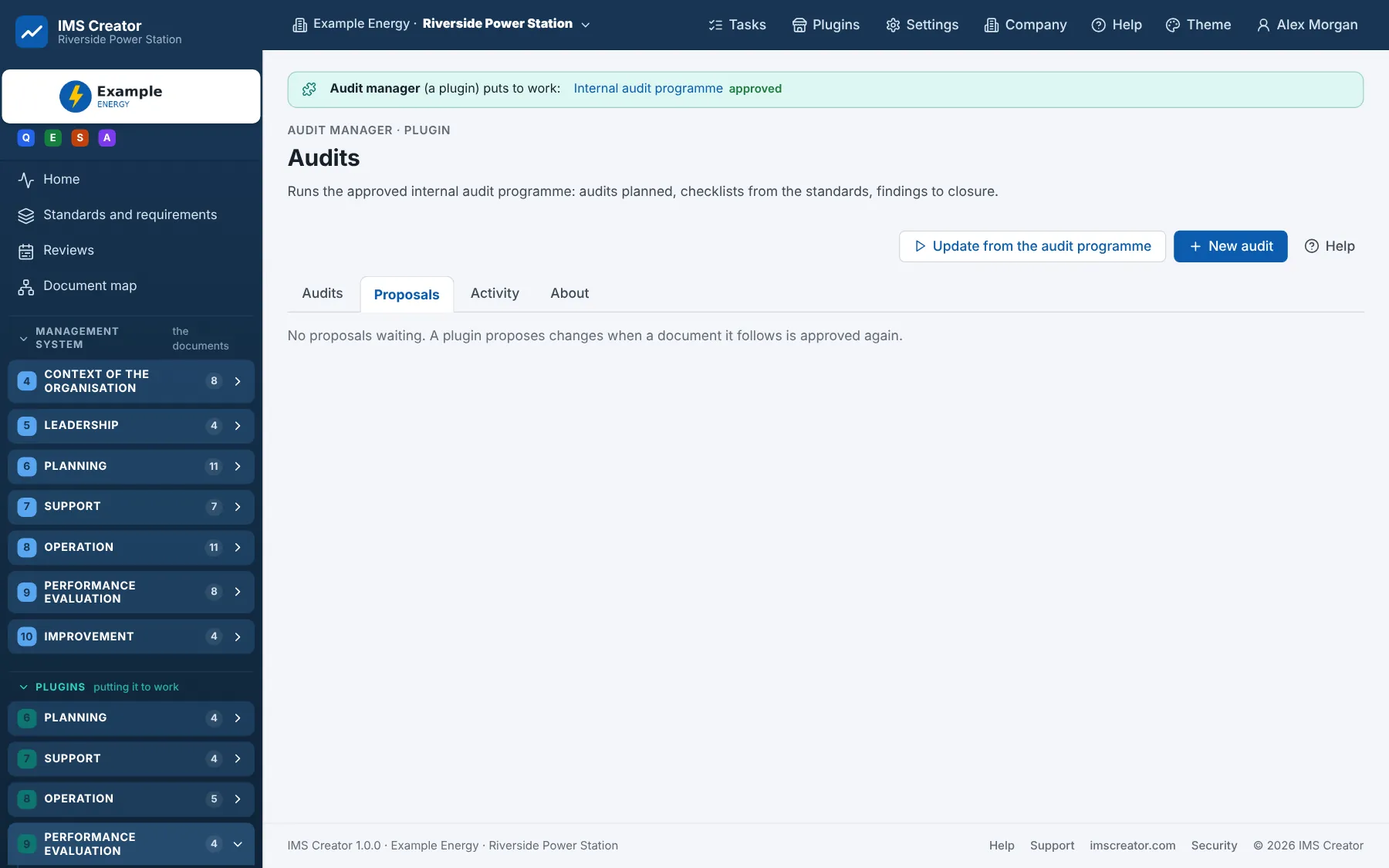
Plugins read what your approved documents say and run it, day to day. When a document is approved again, they propose what changes.
No templates to fill in from scratch, and no consultant's binder to keep alive.
Any of ten ISO standards. They share one structure, so each requirement is one topic, showing where every standard asks for it.
Corporate and site facts, entered once and verified by the people who know. Every document draws on them.
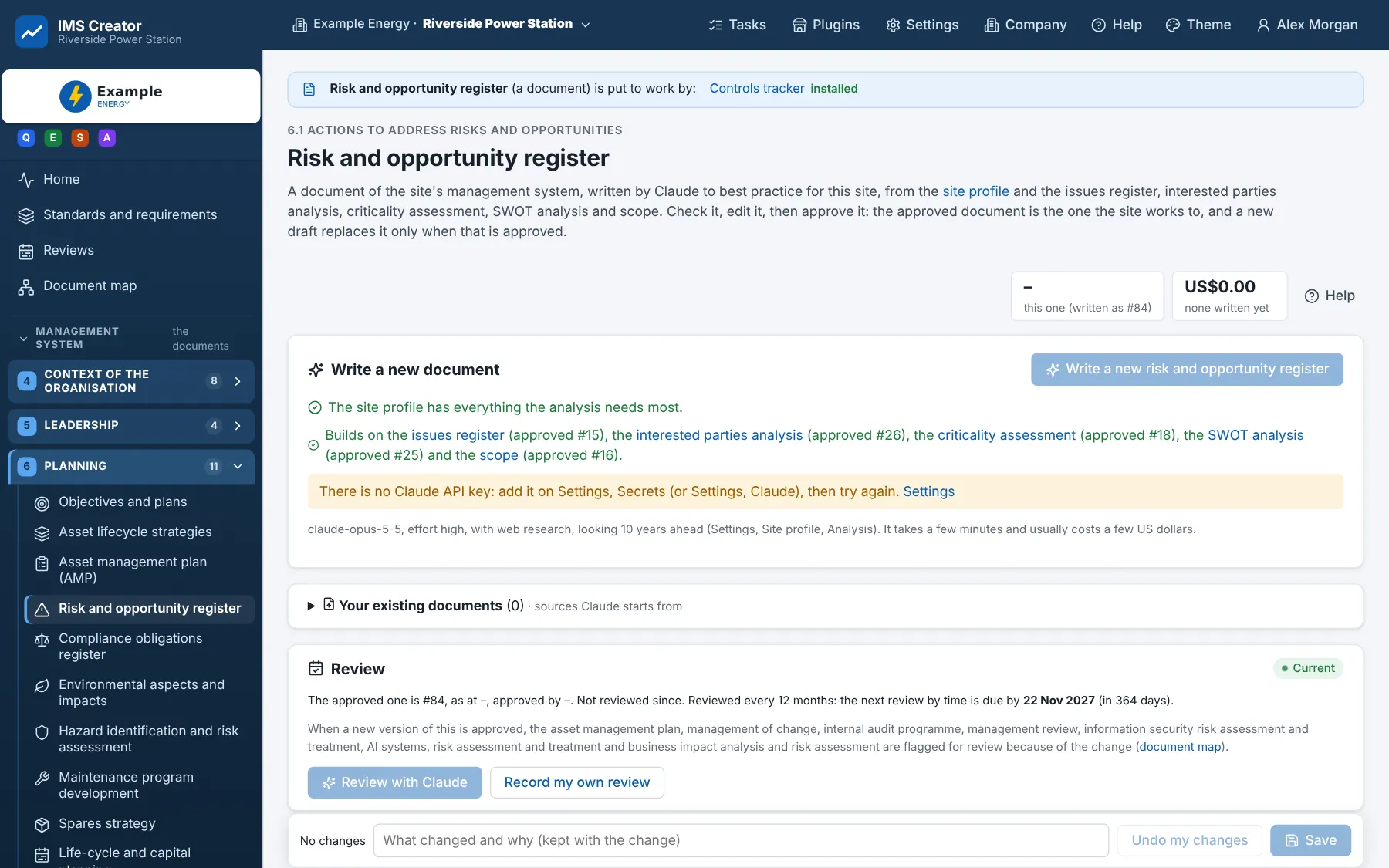
Claude drafts each document from your facts and the standard. Your people comment, ask for changes, see the differences, and approve.
Plugins turn approved documents into work orders, audits and checks, and propose what changes when a document does.
Shown with a demonstration company: a power station applying five standards.
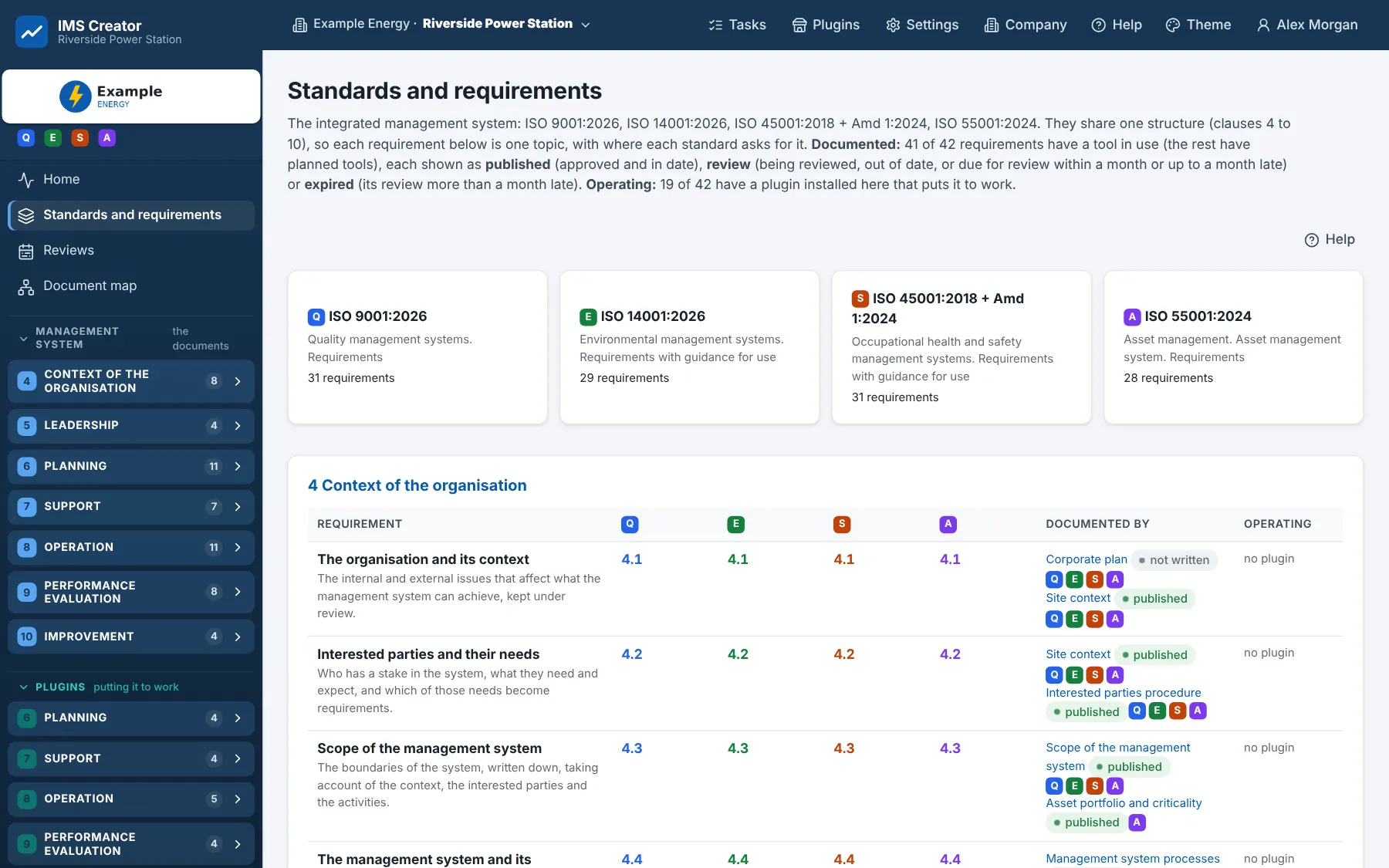
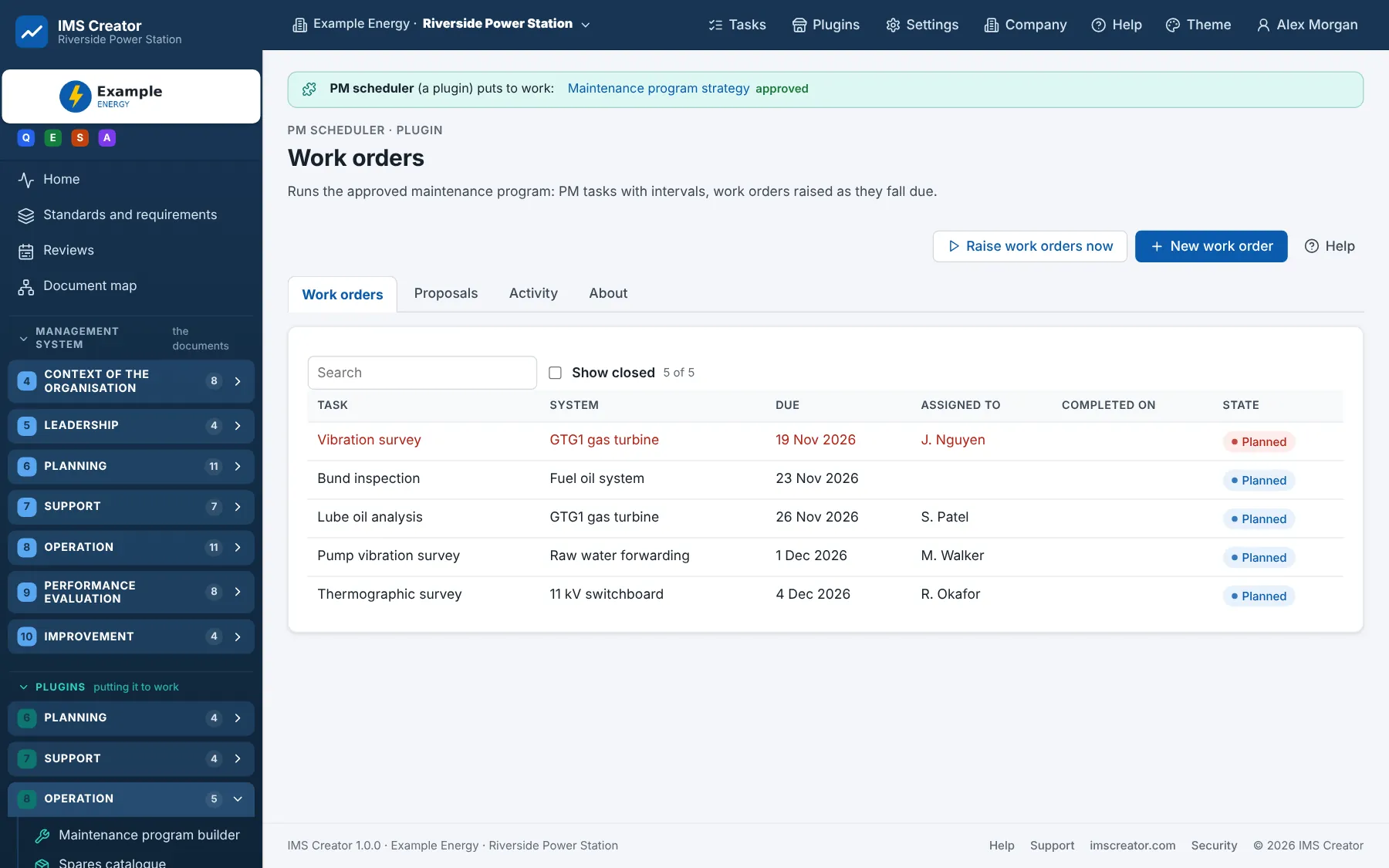
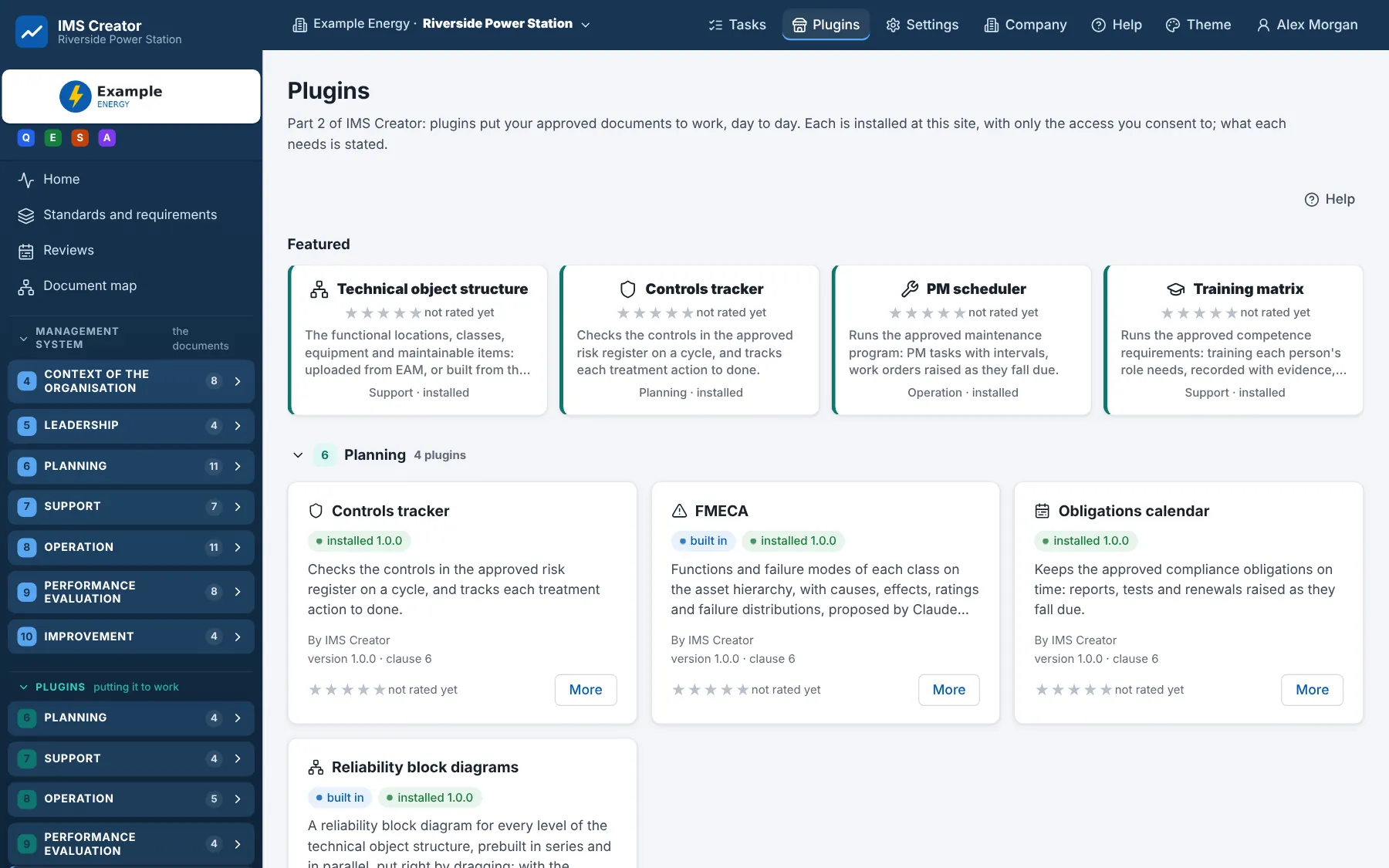
Choose the standards you apply, at company level, and change them as you grow. They share one structure, so adding a standard adds what is specific to it, not a second system.
Requirements laid out by the clauses they share, with where each standard asks and what meets it.
Company and site facts entered once, verified by those who know, and used by every document.
Comments for the next draft, differences shown, approval by the right people, every version kept.
Risks and opportunities, obligations, aspects, hazards and objectives, worked in place, rated on your matrix.
Asset registers, technical object structure, FMECA, maintenance program, spares and meters, with exports ready to load into your EAM.
Title blocks read, tags and links found, every drawing searchable. The drawings themselves stay on your computer.
Corporate documents shared, site documents apart, and company admins across every site.
Drafting runs on your own Claude account: the Anthropic API, AWS Bedrock or Google Vertex AI.
Each plugin reads the documents you approve and runs what they say. It runs at one site, in a sandbox, with only the access you consent to, and its records are yours to export.
For the operators who hold ISO certifications and the physical assets behind them, from a single plant to a national portfolio.
Designed to the OWASP ASVS level 2, with a security statement written for your risk and procurement teams.
Each company has its own databases and file store. No query or screen spans companies, and a test proves it on every release.
Our administrators see counts and service health, never a document, a file name or a person's name.
An authenticator code before the password, breached-password checks, lockouts, and a hash-chained audit log.
On encrypted disks in Australia, behind Cloudflare's firewall and bot protection, with no port open to the internet.
Continuous archiving, encrypted nightly backups kept off-site, and a restore tested every quarter.
Plugins run in WebAssembly with no network or file access, limited memory and time, and only the permissions you grant.
Every plan is free during early access. Sign up, we check your company by hand, and you are invited as its first admin.
For a single operating site, certified or on its way.
For companies running several sites under one management system.
For large or regulated operators with requirements of their own.
Free during early access: we tell you well before any price applies, and you choose then. Claude usage is billed by your own provider, on your own account.
ISO 9001, 14001, 45001, 55001, 50001, 22000 and 22301, and ISO/IEC 27001, 20000-1 and 42001, in their current editions. You choose the ones your company applies, and can add or remove them at any time.
No. IMS Creator lays out what each standard asks for and shows what is in place, so it works for a first certification as well as for a mature system that needs to be kept current and joined up.
Claude drafts them from your verified company and site facts and from what the standard asks. Your people review each draft, comment for the next one, see what changed, and approve. Nothing is in force until a person approves it.
Claude, on your own account: the Anthropic API, AWS Bedrock or Google Vertex AI, in the region you choose (Bedrock and Vertex offer Australian regions). Your provider bills you directly; your key is encrypted with your company's own key and never shown again.
In Australia, in databases of your company's own, apart from every other customer's. Our operators cannot see your content. Read the security overview.
Asset registers import from spreadsheets and export ready to load into your EAM, and asset data can be read from your EAM's exports. The PM scheduler runs the approved maintenance program in IMS Creator today; direct connections from plugins to your EAM and SharePoint are on the way.
Yes. Anyone can register as a publisher, start from the template and the kit, and submit a plugin. It is checked automatically, reviewed against a public policy, and then listed in the marketplace. More for developers.
It is yours. Documents download as SharePoint-ready packages, registers and plugin records export, and the audit log exports too. Then we delete it.
A 30-minute walk-through with your standards and your kind of site. Then a trial with your own facts.